I think Hastings is right to be concerned about "how does this end?" not only because of the previous conflicts but because of comments coming out of America. The US seem to be saying to the Iranian people "we are giving you a chance to determine your future", which sounds like "we've done our bit, now over to you". What their "bit" amounts to remains to be seen but I can't imagine the Israelis leaving the nuclear capability intact or one set of extremist Mullahs to be replaced by something similar. For their own safety alone, there has to be more to come or they will be in the same situation in a few years time.
Where I do have a problem with the article is when he writes "it would have been much better for the world if Trump and Binyamin Netanyahu had not gone down this route. Containment is almost always a better strategy than military assault."
He doesn't say what form the containment would take. How do you contain a country that has vowed to eliminate Israel while pushing ahead with it's nuclear programme and at the same time funding terrorists in the surrounding countries? Israel couldn't afford to wait and with the Iranian public unlikely to be supportive of the regime after recent events, now was seen as the time to strike.
Personally, I think had it not been carried out by Israel and the US, there would be a general sense of approval that the main supporter of world terrorism has been eliminated, but because it does involve those two, the bombing is condemned by the usual suspects.
Iran's reach has been far and wide and although some people can't bring themselves to admit it, Israel and the US are doing the rest of the world a favour.
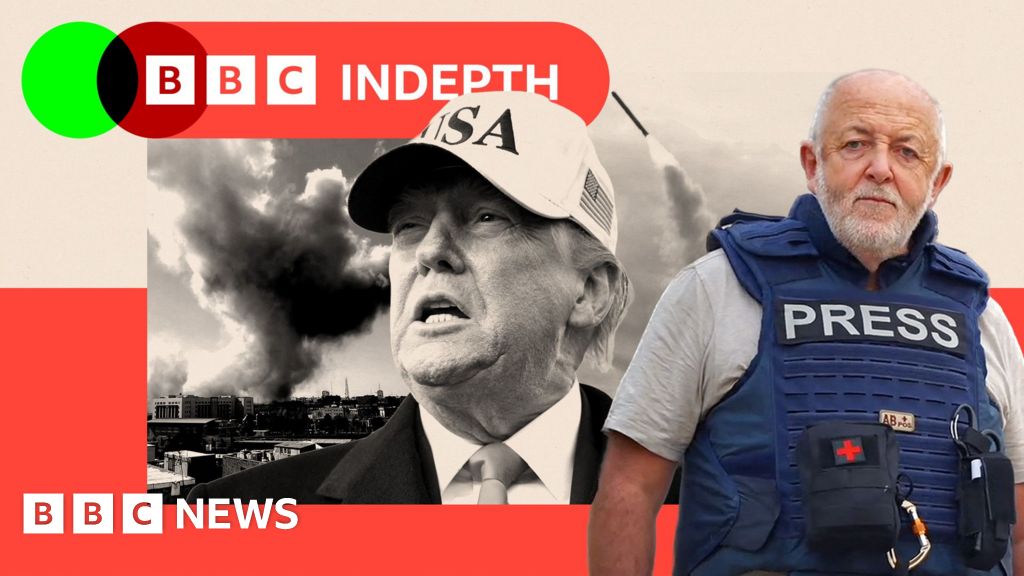
This by Jeremy bowen makes some interesting points about the regimes in Syria and Libya and that in Iran and it's capability to survive.
It's hard to predict how the war will end - but those fighting know how they would like it to.

www.bbc.com
"The killing of the supreme leader and his top military advisers was a hammer blow to the regime. But it does not necessarily mean that it will collapse.
Ayatollah Ruhollah Khomeini and its other founders nearly 50 years ago designed its institutions to survive wars and assassinations. It is not a one-man show. The Syrian and Libyan states under Assad and Gaddafi were built around ruling families. When the families were removed – Gaddafi was killed and Bashar al-Assad fled – the regimes collapsed.
Iran's regime is a state system, resting on a complex and dense network of political and religious institutions with overlapping responsibilities. It is engineered to survive wars and assassinations.
That does not mean it will. The Islamic Republic's system faces its sternest test. But it has planned for this moment."
"It has a powerful and ruthless apparatus of security, repression and coercion. In January its men went on to the streets, following orders to kill thousands of protestors. So far - and as I have said repeatedly, it's only day three of the war as I write this - there is no sign that the regime's armed forces are melting away, as Assad's did after he fled to Moscow in December 2024.
As well as conventional armed forces and well-armed police, there is the Islamic Revolutionary Guards Corps, with an explicit mandate to protect the regime at home and abroad. It exists to be the muscle behind the velayat-e faqih, the guardianship of the jurist. That is the key doctrine of the Islamic revolution in Iran, which justifies the rule of Shia religious leaders.
The IRGC is believed to have 190,000 on active duty and as many as 600,000 reservists. Religious doctrine apart, it also runs much of the economy. Its leaders have financial as well as ideological reasons to stay loyal.
The IRGC is backed by the Basij, a volunteer paramilitary force. Its estimated 450,000 members have a reputation for loyalty to the regime and for thuggery.
I saw them in action in Tehran as the regime's first line of defence during the protests that followed the disputed 2009 election, threatening and beating protestors on the streets with clubs and rubber truncheons. Behind them were heavily armed police and IRGC men. The Basij also had flying squads on motorcycles that raced around the city dealing with outbreaks of dissent."
"The precedents are not good. The removal of Iraq's Saddam Hussein in 2003 led to a catastrophe - long years of war that incubated jihadist extremist movements that still exist.
Libya, a country with enough oil to give its small population western standards of living, is broken and impoverished, a failed state 15 years after Gaddafi was removed from power and killed. Western countries who celebrated his fall and made it happen essentially washed their hands of responsibility after the country broke up."
"Military action by the US and Israel is pulverising Iran's military capacities. That changes the equation in the Middle East, even if the regime survives.
Many, most likely most Iranians, would rejoice if it fell. But it would be an immense challenge to replace a regime removed by force with a peaceful, coherent alternative.
Trump's gamble is that it will be possible, that this war will make the Middle East a better and safer place. The odds against that happening are challenging."
No way of predicting how this will turn out, the tangerine turd's messaging is at odds with some in his administration and will no doubt change day by day.