Off Topic The "That's interesting"/geek thread

  • Please bear with us on the new site integration and fixing any known bugs over the coming days. If you can not log in please try resetting your password and check your spam box. If you have tried these steps and are still struggling email [email protected] with your username/registered email address
  • Log in now to remove adverts - no adverts at all to registered members!
Million-year-old skull rewrites human evolution, scientists claim
59 minutes ago
Share
Save
You must log in or register to see images
Pallab GhoshScience Correspondent
You must log in or register to see images
BBC News
Replica: the skull is a million years old but has some modern features
A million-year-old human skull found in China suggests that our species, Homo sapiens, began to emerge at least half a million years earlier than we thought, researchers are claiming in a new study.

It also shows that we co-existed with other sister species, including neanderthals, for much longer than we've come to believe, they say.

The scientists claim their analysis "totally changes" our understanding of human evolution and, if correct, it would certainly rewrite a key early chapter in our history.

But other experts in a field where disagreement over our emergence on the planet is rife, say that the new study's conclusions are plausible but far from certain.


The discovery, published in one if the world's leading scientific journals, Science, shocked the research team, which included scientists from a university in China and the UK's Natural History Museum.

"From the very beginning, when we got the result, we thought it was unbelievable. How could that be so deep into the past?" said Prof Xijun Ni of Fudan University, who co-led the analysis.

"But we tested it again and again to test all the models, use all the methods, and we are now confident about the result, and we're actually very excited."

You must log in or register to see images
Fudan University
The skulls were discovered by a Chinese team in Hubei Province in central China who compared them with other human species

When scientists found the skull, named Yunxian 2, they assumed it belonged to an earlier ancestor of ours, Homo erectus, the first large-brained humans. That's because it dated back about a million years, long before more advanced humans were thought to have emerged.

Homo erectus eventually evolved and began to diverge 600,000 years ago into Neanderthals and our species – Homo sapiens.

But the new analysis of Yunxian 2, which has been reviewed by experts independent of the research team, suggests that it is not Homo erectus.

It is now thought to be an early version of Homo longi, a sister species at similar levels of development to neanderthals and Homo sapiens.

Genetic evidence suggests it existed alongside them, so if Yunxian 2 walked the Earth a million years ago, say the scientists, early versions of neanderthal and our own species probably did too.

This startling analysis has dramatically shifted the timeline of the evolution of large-brained humans back by at least half a million years, according to Prof Chris Stringer of the Natural History Museum, a co-lead on the research.

He said there are likely to be million year-old fossils of Homo sapiens somewhere on our planet - we just haven't found them yet.


You must log in or register to see images


0:45
Watch Science Correspondent Pallab Ghosh explain how the human family tree may have been redrawn

There are two ways to pinpoint the species of an early human and work out when it walked the Earth - analysing the shape of the skull and its genetic data. In the case of Yunxian 2 both methods were used, and each came to the same conclusion.

But other researchers, such as Dr Aylwyn Scally, an evolutionary geneticist at Cambridge University, say there are considerable uncertainties in both methods.

"One has to be particularly tentative about the the timing estimates, because those are very difficult to do, regardless of what evidence you're looking at, be that genetic or fossil evidence," he said.

"Even with the largest amount of genetic data, it is very difficult to place a time when these populations may have coexisted to within 100,000 years, or or even more."

He added that while Profs Ni and Stringer's conclusions were plausible, they were far from certain, and that more evidence was needed to be sure.

"That picture is still quite unclear to us, so if the conclusions of this research are supported by other analyses, ideally from some genetic data, then I think we would start to be increasingly confident about it," he told BBC News.

The earliest known evidence for early Homo sapiens in Africa is 300,000 years ago, so it is tempting to conclude that our species might have evolved first in Asia.

But there is not enough evidence to be sure at this stage, according to Prof Stringer, because there are human fossils in Africa and Europe that are also a million years old that need to be incorporated into the analysis.

"There is some genetic evidence that points to the even earlier emergence of our species which may have recombined with our lineage, but this is not yet proven," he told BBC News.

The earlier timeline means that the three species of humans co-existed on the planet for around 800,000 years, much longer than previously thought, perhaps interacting and interbreeding in that time.

You must log in or register to see images
Fudan University
The white skulls are the orginal, distorted fossils and the grey ones are replica's that have been computer corrected

The earlier emergence also helps make sense of dozens of human fossil remains dating from 800,000 years ago and 100,000 years ago that scientists have found hard to classify and find their place in the human family tree – the so-called "muddle in the middle".

But the earlier emergence of Homo sapiens, Homo longi and Neanderthals neatly solves the problem. It means that is now possible to group the hard-to-classify fossils as subgroups belonging to one of the "big three," or their more primitive ancestors, Asian Homo erectus and heidelbergensis, according to Prof Ni.

"Human evolution is like a tree," he said. "This tree included several branches, and there were three major branches that are closely related, and they may have some interbreeding to each other, and they coexisted for almost 1 million years. So this is an unbelievable result."

The skull was excavated along with two others from Hubei Province. But they were damaged and crushed, which is one of the reasons that Yunxian 2 had been miscategorised as erectus.

To restore them to their original shape, Prof Ni's team scanned the skulls and undistorted them using computer modelling techniques and then printed replicas on a 3D printer.

Seeing them as they truly were enabled the scientists to reclassify them as a separate – more advanced group of human.
 
Million-year-old skull rewrites human evolution, scientists claim
59 minutes ago
Share
Save
You must log in or register to see images
Pallab GhoshScience Correspondent
You must log in or register to see images
BBC News
Replica: the skull is a million years old but has some modern features
A million-year-old human skull found in China suggests that our species, Homo sapiens, began to emerge at least half a million years earlier than we thought, researchers are claiming in a new study.

It also shows that we co-existed with other sister species, including neanderthals, for much longer than we've come to believe, they say.

The scientists claim their analysis "totally changes" our understanding of human evolution and, if correct, it would certainly rewrite a key early chapter in our history.

But other experts in a field where disagreement over our emergence on the planet is rife, say that the new study's conclusions are plausible but far from certain.


The discovery, published in one if the world's leading scientific journals, Science, shocked the research team, which included scientists from a university in China and the UK's Natural History Museum.

"From the very beginning, when we got the result, we thought it was unbelievable. How could that be so deep into the past?" said Prof Xijun Ni of Fudan University, who co-led the analysis.

"But we tested it again and again to test all the models, use all the methods, and we are now confident about the result, and we're actually very excited."

You must log in or register to see images
Fudan University
The skulls were discovered by a Chinese team in Hubei Province in central China who compared them with other human species

When scientists found the skull, named Yunxian 2, they assumed it belonged to an earlier ancestor of ours, Homo erectus, the first large-brained humans. That's because it dated back about a million years, long before more advanced humans were thought to have emerged.

Homo erectus eventually evolved and began to diverge 600,000 years ago into Neanderthals and our species – Homo sapiens.

But the new analysis of Yunxian 2, which has been reviewed by experts independent of the research team, suggests that it is not Homo erectus.

It is now thought to be an early version of Homo longi, a sister species at similar levels of development to neanderthals and Homo sapiens.

Genetic evidence suggests it existed alongside them, so if Yunxian 2 walked the Earth a million years ago, say the scientists, early versions of neanderthal and our own species probably did too.

This startling analysis has dramatically shifted the timeline of the evolution of large-brained humans back by at least half a million years, according to Prof Chris Stringer of the Natural History Museum, a co-lead on the research.

He said there are likely to be million year-old fossils of Homo sapiens somewhere on our planet - we just haven't found them yet.


You must log in or register to see images


0:45
Watch Science Correspondent Pallab Ghosh explain how the human family tree may have been redrawn

There are two ways to pinpoint the species of an early human and work out when it walked the Earth - analysing the shape of the skull and its genetic data. In the case of Yunxian 2 both methods were used, and each came to the same conclusion.

But other researchers, such as Dr Aylwyn Scally, an evolutionary geneticist at Cambridge University, say there are considerable uncertainties in both methods.

"One has to be particularly tentative about the the timing estimates, because those are very difficult to do, regardless of what evidence you're looking at, be that genetic or fossil evidence," he said.

"Even with the largest amount of genetic data, it is very difficult to place a time when these populations may have coexisted to within 100,000 years, or or even more."

He added that while Profs Ni and Stringer's conclusions were plausible, they were far from certain, and that more evidence was needed to be sure.

"That picture is still quite unclear to us, so if the conclusions of this research are supported by other analyses, ideally from some genetic data, then I think we would start to be increasingly confident about it," he told BBC News.

The earliest known evidence for early Homo sapiens in Africa is 300,000 years ago, so it is tempting to conclude that our species might have evolved first in Asia.

But there is not enough evidence to be sure at this stage, according to Prof Stringer, because there are human fossils in Africa and Europe that are also a million years old that need to be incorporated into the analysis.

"There is some genetic evidence that points to the even earlier emergence of our species which may have recombined with our lineage, but this is not yet proven," he told BBC News.

The earlier timeline means that the three species of humans co-existed on the planet for around 800,000 years, much longer than previously thought, perhaps interacting and interbreeding in that time.

You must log in or register to see images
Fudan University
The white skulls are the orginal, distorted fossils and the grey ones are replica's that have been computer corrected

The earlier emergence also helps make sense of dozens of human fossil remains dating from 800,000 years ago and 100,000 years ago that scientists have found hard to classify and find their place in the human family tree – the so-called "muddle in the middle".

But the earlier emergence of Homo sapiens, Homo longi and Neanderthals neatly solves the problem. It means that is now possible to group the hard-to-classify fossils as subgroups belonging to one of the "big three," or their more primitive ancestors, Asian Homo erectus and heidelbergensis, according to Prof Ni.

"Human evolution is like a tree," he said. "This tree included several branches, and there were three major branches that are closely related, and they may have some interbreeding to each other, and they coexisted for almost 1 million years. So this is an unbelievable result."

The skull was excavated along with two others from Hubei Province. But they were damaged and crushed, which is one of the reasons that Yunxian 2 had been miscategorised as erectus.

To restore them to their original shape, Prof Ni's team scanned the skulls and undistorted them using computer modelling techniques and then printed replicas on a 3D printer.

Seeing them as they truly were enabled the scientists to reclassify them as a separate – more advanced group of human.
“The earlier timeline means that the three species of humans co-existed on the planet for around 800,000 years, much longer than previously thought, perhaps interacting and interbreeding in that time.”

Must have found their way to Norwich too then!
 
“The earlier timeline means that the three species of humans co-existed on the planet for around 800,000 years, much longer than previously thought, perhaps interacting and interbreeding in that time.”

Must have found their way to Norwich too then!
Aaarrrgh
 
Life-changing eye implant helps blind patients read again

You must log in or register to see images


0:40
Sheila Irvine, who is registered blind, punches the air with joy at being able to read again
A group of blind patients can now read again after being fitted with a life-changing implant at the back of the eye.

A surgeon who inserted the microchips in five patients at Moorfields Eye Hospital in London says the results of the international trial are "astounding".

Sheila Irvine, 70, who is registered blind, told the BBC it was "out of this world" to be able to read and do crosswords again. "It's beautiful, wonderful. It gives me such pleasure."

The technology offers hope to people with an advanced form of dry age-related macular degeneration (AMD), called geographic atrophy (GA), which affects more than 250,000 people in the UK and five million worldwide.


In those with the condition - which is more common in older people - cells in a tiny area of the retina at the back of the eye gradually become damaged and die, resulting in blurred or distorted central vision. Colour and fine detail are often lost.

The new procedure involves inserting a tiny 2mm-square photovoltaic microchip, with the thickness of a human hair, under the retina.

Patients then put on glasses with a built-in video camera. The camera sends an infrared beam of video images to the implant at the back of the eye, which sends them on to a small pocket processor to be enhanced and made clearer.

The images are then sent back to the patient's brain, via the implant and optic nerve, giving them some vision again.

The patients spent months learning how to interpret the images.

Mahi Muqit, consultant ophthalmic surgeon at Moorfields Eye Hospital in London, who led the UK arm of the trial, told the BBC it was "pioneering and life-changing technology".

"This is the first implant that's been demonstrated to give patients meaningful vision that they can use in their daily life, such as reading, writing.

"I think this is a major advance," he said.

How the implant technology works

For the research, published in the New England Journal of Medicine, 38 patients with geographic atrophy in five European countries took part in the trial of the Prima implant, which is made by California biotech Science Corporation.

Of 32 patients given the implant, 27 were able to read again using their central vision. After a year, this equated to an improvement of 25 letters, or five lines, on an eye chart.

For Sheila, from Wiltshire, the improvement is even more dramatic. Without the implant, she is completely unable to read.

But when we filmed Sheila reading an eye chart at Moorfields Hospital, she did not make a single error. After completing it, she punched the air and cheered.

'I am one happy bunny'
You must log in or register to see images

Sheila says she rushes her chores every day in order to sit down and put on the special glasses

The task took huge concentration. Sheila had to put a pillow under her chin in order to steady the feed from the camera, which can focus on just one or two letters at a time. At some points she needed the device switched to magnification mode, especially to distinguish between the letters C and O.

Sheila began losing her central vision more than 30 years ago, due to loss of cells in the retina. She describes her vision as like having two black discs in each eye.

Sheila gets around using a white cane because her very limited peripheral vision is completely blurred. She is unable to read even the largest street signs when outdoors.

When she had to give up her driving licence, she says she cried.

But after having an implant fitted around three years ago, she is delighted by her progress, as is the medical team at Moorfields.

"I am able to read my post, books, and do crosswords and Sudoku," she says.

When asked if she ever thought she'd read again, Sheila replied: "Not on your nelly!"

"It is amazing. I am one happy bunny," she adds.

"Technology is moving so fast, it's amazing that I am part of it."

You must log in or register to see images

Sheila concentrates hard in order to read

Sheila doesn't wear the device when outdoors. In part, this is because it requires great concentration - her head has to be held very still in order to read. She also does not want to become over-reliant on the device.

Instead, she says she "rushes her chores" at home each day before sitting down and putting on the special glasses.

The Prima implant is not yet licensed so is not available outside of clinical trials, and it's unclear how much it may eventually cost.

Nonetheless, Mahi Muqit said he hoped it would be available to some NHS patients "within a few years."

It's possible the technology could be used to help people with other eye conditions in the future.

Dr Peter Bloomfield, director of research at Macular Society, says the results are "encouraging" and "fantastic news" for those who currently have no treatment options.

"Artificial vision may offer a lot of hope to many, particularly after previous disappointments in the world of dry AMD treatment.

"We are now watching closely to see if the Prima implant will be approved for use here in the UK, and crucially whether it could be made available on the NHS."

The implant would not help restore sight in people born blind, because they don't have a functioning optic nerve to pass signals to the brain.
 
  • Like
Reactions: Steelmonkey
When warring troops stopped fighting and shared a picnic
9 November 2025
Share
Save
Jo LonsdaleNorth East and Cumbria Investigations
You must log in or register to see images
Trudy Johnson
The picnic and prayer truce on Aka island was described in a now declassified report written in July 1945
A fragile truce near the end of one of the bloodiest land battles of World War Two saw US and Japanese soldiers suspend their fighting and sit down together... for a picnic. According to the Newcastle University professor who helped research it, the event deserves much greater recognition.


"It is just as remarkable as the truce of World War One when British and German soldiers stopped fighting on Christmas Day, perhaps even more so given the hatred and fear between the US and Japanese troops at the time," said political geographer Nick Megoran.

He was part of a team which travelled to an isolated beach on Aka island in Japan to commemorate an event many islanders themselves know little about.

It was there in 1945, in the shadow of the Battle of Okinawa, that US and Japanese troops stopped fighting to talk, eat and pray together.

Prof Megoran said: "Remembrance Sunday 80 years on is a really appropriate time to talk about an incredible moment which has been largely overlooked."

You must log in or register to see images
Nick Megoran
Prof Hiroshi Sakai (centre) heard about the truce during a chance conversation with Aka islanders on a flight

For decades, the event was little known beyond the memories of those who were there.

But in 2004 Japanese University lecturer Hiroshi Sakai, then a newspaper reporter, was sitting on a plane next to an elderly couple who explained they had been children on Aka during the war.

"I asked them if they had endured terrible experiences," he said, but they explained that American and Japanese soldiers had held talks which had led to a state of ceasefire.

Prof Sakai said he had been "astonished".

"Even though it was the war's final stages, Japanese forces were still mounting desperate resistance at the end of June," he said.

He began his own investigation and, in March 2024, sent an email to Prof Megoran who had published research on the 1914 Christmas truces.

You must log in or register to see images

Nick Megoran said he was "spellbound" when he first saw a photograph of the truce

Prof Sakai attached a photograph of Japanese and US soldiers praying together on a beach in June 1945.

"I was spellbound," Prof Megoran said.

"I just sat there looking at it for a very long time and, actually, my eyes welled up with tears.

"In a war when each side dehumanised the other, when civilians took their own lives rather than surrender, for an event like that to take place.

"I just knew this was a story which needed telling."

You must log in or register to see images
Trudy Johnson
The Americans spent several days circumnavigating the island appealing to the Japanese to surrender

The Battle of Okinawa saw massive casualties on both sides, including many civilians.

In June 1945, United States Lt Col George Clark was tasked with securing Aka where a Japanese garrison was based.

He assembled a small team of American officers, along with Japanese prisoners of war who agreed to cooperate in the hope of saving lives.

They spent several days circumnavigating the island, using loudspeakers to broadcast appeals to surrender.

You must log in or register to see images
Trudy Johnson
Major Yutaka Umezawa (right), a Japanese PoW, helped build trust between the two sides

The deadlock broke when one of the team, Lt David Osborn, swam ashore and left flags with messages on.

Eventually the garrison commander, Major Yoshihiko Noda, indicated he would be willing to talk but only in the presence of Major Yutaka Umezawa, who had been injured and captured by the Americans.

Trudy Johnson, Lt Col Clark's daughter, said her father and Major Umezawa "had become close".

"One night my Dad talked to him for hours trying to persuade him to help," she said.

You must log in or register to see images
Trudy Johnson
Trudy Johnson says her father was proud of what he achieved in 1945

On 26 June, a group of US forces and Major Umezawa landed on the shore, with Japanese soldiers fanned out in the hills above.

"They could have been shot at any time, but my father always said he wasn't afraid," Ms Johnson said.

Instead of bullets, Major Noda appeared.

The two commanders saluted, put down their weapons and began talking. As the negotiations continued, a roast pork lunch was assembled for everyone and they picnicked together on the beach.

In his official report Lt Col Clark described it as "the most amazing spectacle it has been my lot to behold".

The Japanese said they were unable to surrender, but a truce was agreed.

Before the US troops departed, Lt Col Clark asked if the Japanese "would like to join the group in a prayer to the Supreme Being of all faiths for international understanding and peace", led by the US chaplain, which they agreed to do.

The truce held until the Japanese surrender in August and there was no further loss of life on Aka.

You must log in or register to see images
Nick Megoran
Prayers were held at the spot exactly 80 years on from the original truce

"When we visited in June we interviewed the children of participants and even a civilian eyewitness," Prof Megoran said.

"Younger people on Aka don't know much about the truce but the older people remember."

Pete Alston, from Jesmond Parish Church in Newcastle, led prayers in both English and Japanese at the same spot where the warring soldiers first talked 80 years ago.

"It was such a small event in the midst of so much violence," he said of the picnic in 1945.

You must log in or register to see images
Trudy Johnson
Lt Col George Clark never returned to Japan

Ms Johnson, who had kept all her father's photographs from the time, believes the story is not better known because neither side were following orders.

The US soldiers failed to secure a surrender and the Japanese soldiers negotiated with the enemy.

Prof Sakai agrees and added: "For the former Japanese military, an unauthorised negotiation constituted an extremely grave breach of military discipline."

You must log in or register to see images
Nick Megoran
The Cornerstone of Peace Memorial is dedicated to more than 200,000 people who lost their lives during the Battle of Okinawa

Lt Col Clark never returned to Japan, although in 1987 he was interviewed by a Japanese TV channel about his wartime experiences, with his daughter listening in.

"For many years he believed some of the men on the Japanese side had been executed for treason following the truce," Ms Johnson said.

"That's the only time I ever saw my dad cry - when they told him that wasn't true.

"I am an old lady now and I needed someone to pick this up from me, and I'm so glad Nick has come along.

"Of course it was a team effort, there were many brave men involved including the Japanese PoWs who risked their lives by cooperating.

"But my Dad was a good man, he knew what they were doing back then was the right thing."
 
  • Like
Reactions: Steelmonkey
never heard of this

Saudia Flight 163Not to be confused with Saudia Flight 162.
Saudia Flight 163
You must log in or register to see images

The damage to the aircraft after the fire
Accident
Date
19 August 1980
Summary Failure to evacuate following in-flight fire of unknown origin
Site Riyadh International Airport,
Riyadh, Saudi Arabia
You must log in or register to see images
24°42′42″N 46°43′37″E
Aircraft
You must log in or register to see images

HZ-AHK, the aircraft involved in the accident, pictured in 1979
Aircraft type Lockheed L-1011-200 TriStar
Operator Saudia
IATA flight No. SV163
ICAO flight No. SVA163
Call sign SAUDIA 163
Registration HZ-AHK
Flight origin Quaid-e-Azam Int'l Airport,
Karachi, Pakistan
Stopover Riyadh International Airport,
Riyadh, Saudi Arabia
Destination Kandara Airport,
Jeddah, Saudi Arabia
Occupants 301
Passengers 287
Crew 14
Fatalities 301
Survivors 0
Saudia Flight 163 was a scheduled Saudia passenger flight departing from Quaid-e-Azam Airport in Karachi, Pakistan, bound for Kandara Airport in Jeddah, Saudi Arabia, via Riyadh International Airport in Riyadh, Saudi Arabia, which caught fire after takeoff from Riyadh International Airport (now the Riyadh Air Base)[1] on 19 August 1980. Although the Lockheed L-1011-200 TriStar made a successful emergency landing at Riyadh, the flight crew failed to perform an emergency evacuation of the airplane, leading to the deaths of all 287 passengers and 14 crew on board the aircraft from smoke inhalation.

The accident is the deadliest aviation disaster involving a Lockheed L-1011 TriStar,[2] and the deadliest to occur in Saudi Arabia.[1][3] At the time, this was the second-deadliest aircraft accident in the history of aviation involving a single airplane after Turkish Airlines Flight 981 and the third-deadliest overall after Turkish Airlines Flight 981 and the Tenerife airport disaster.[4]

Aircraft
The aircraft involved in the accident was a Lockheed L-1011-200 TriStar, registered in Saudi Arabia as HZ-AHK with serial number 1169. The aircraft was certified on 23 July 1979 and was delivered to Saudia nearly a month later. It had accumulated a total of 3,023 flight hours and 1,759 cycles. HZ-AHK was equipped with three Rolls Royce RB211-524 engines with each having an average of 4,000 total engine hours.[5]: 89 

Passengers and crew
Nationalities of the victims[citation needed]
Nationality Number
Canada 1
China 1
Finland 1
France 5[6]
You must log in or register to see images
Iran 81
Ireland 1
Japan 1
South Korea 4
Pakistan 64
Philippines 6
Saudi Arabia 125
Taiwan 1
Thailand 2
United Kingdom 5[7]
United States 3
Total 301
Of the flight's passengers, 82 boarded in Karachi, while the remaining 205 boarded in Riyadh. The majority of the passengers were Saudis and Pakistani religious pilgrims on their way to Mecca. In addition to the Saudis and Pakistanis, 32 religious pilgrims were from Iran. Also, a small number of passengers were from various countries, who were heading to Jeddah for diplomatic missions.[5]: 89 [8][9] Four of the passengers were British.[7]

There was a total of three crew members in the flight deck. All were inexperienced with the aircraft type:

  • The captain of the flight was 38-year-old Mohammed Khowyter (محمد الخويطر), a Saudi national hired by Saudia in 1965 who had flown the Douglas DC-3, DC-4, McDonnell Douglas DC-9, Boeing 707 and 737. Despite being certified to fly such a wide range of aircraft, Khowyter's records described him as a slow learner and in need of more appropriate training. Khowyter had 7,674 flying hours but only 388 hours on the TriStar – a significantly more sophisticated aircraft.[5]: 89 
  • The first officer was 26-year-old Sami Hasanain (سامي حسنين), also a Saudi national, who joined the airline as a pilot in 1977. During training Hasanain had at one point been removed from flying school for poor performance. He had 1,615 flying hours in total but only 125 hours in the TriStar: he received his type rating just 11 days before the accident.[5]: 82–83 
  • The flight engineer was 42-year-old Bradley Curtis. Previously certified as a captain of the antiquated and comparatively unsophisticated Douglas DC-3, he was hired by Saudia during a major recruitment drive in 1974 and assigned to pilot training for their expanding Boeing 707 and 737 international fleet. He failed to qualify and consequently his employment was terminated in May of 1978 but he appealed his termination and requested to be considered as a Flight Engineer and offered to fund his own training which he completed and was approved as a 707 F/E in November 1978 and in May 1980, after completing a simulator training course at Lockheed California, approved as a Flight Engineer on all routes. It has been reported that Curtis had dyslexia. Curtis had 650 flying hours as an FE, and 157 hours on type.[5]: 84–85 [10]
Six flight attendants were from the Philippines, three were from Pakistan, and one was from the United Kingdom.[11]

Accident
You must log in or register to see images

An overview of Saudia Flight 163 after the fire
Flight 163 departed Quaid-e-Azam International Airport (now Jinnah International Airport) in Karachi, Pakistan, at 18:32 Pakistan time (13:32 UTC) bound for Kandara Airport in Jeddah, Saudi Arabia, with a scheduled intermediate stop at Riyadh Airport. The flight arrived in Riyadh at 19:06 Saudi time (16:06 UTC) and had a two-hour layover for refueling. During the layover, several of the passengers disembarked. After refueling, the flight took off at 21:08 (18:08 UTC) bound for Jeddah.[5]

Almost seven minutes into the flight, the crew received warnings of smoke from the cargo compartment.[5]: 66–67, 98  The crew spent the next four minutes trying to confirm the warnings, after which Flight Engineer Curtis went back into the cabin to confirm the presence of smoke. Captain Khowyter decided to return to the airport, and First Officer Hasanain radioed their intentions at 21:20 (18:20 UTC).

You must log in or register to see images

The remains of HZ-AHK, after the fire
At 21:25 (18:25 UTC), the thrust lever for the number two engine (the center engine) became jammed as the fire burned through the operating cable. At 21:29 (18:29 UTC), the engine was shut down during final approach.[5]: 6  At 21:35 (18:35 UTC), Khowyter declared an emergency and landed back at Riyadh.[12] After touchdown at 21:36 (18:36 UTC), the airplane continued to a taxiway at the end of the runway where it exited the runway, stopping at 21:39 (18:39 UTC), 2 minutes and 40 seconds after touchdown. The airport fire rescue equipment was stationed back on the landing section of the runway, with emergency personnel expecting an emergency stop and evacuation. This meant they had to rush after the aircraft, which had used the entire length of a 4,000-metre (13,000 ft) runway to slow and then exit onto the taxiway. The airplane stopped facing in the opposite direction from landing.[5]: 7 

Once the aircraft had stopped, the crew reported that they were shutting down the engines and about to evacuate. On arrival at the aircraft soon after, however, the rescue personnel found that the two wing-mounted engines were still running, preventing them from opening the doors. These were finally shut down at 21:42 (18:42 UTC), 3 minutes and 15 seconds after the aircraft came to a stop, when communication with the crew was lost. No external fire was visible at this time, but flames were observed through the windows at the rear of the aircraft. Twenty-three minutes after engine shutdown, at 22:05 (19:05 UTC), the R2 door (second door on the right side) was opened by ground personnel. Three minutes later, the interior of the aircraft flashed over, and was destroyed by fire. All 301 occupants on board died.[5]: 8 

Investigation
You must log in or register to see images

Cargo compartment C3 after the fire
The investigation revealed the fire had started in the aft C3 cargo compartment.[5]: 77–78  The fire was intense enough to burn through the cabin floor, causing passengers seated in that area of the cabin to move forward prior to the landing. The source of the fire in compartment C3 could not be determined.[5]: 78  Saudi officials found two butane stoves in the burned-out remains of the airliner, and a used fire extinguisher near one of them.[5]: 35  One early theory was that the fire began in the passenger cabin when a passenger used his own butane stove to heat water for tea.[13] The investigation found no evidence to support this theory.[5]: 78 

Why Captain Khowyter failed to evacuate the aircraft promptly is not known. Saudi reports stated that the crew could not get the plug-type doors to open in time.[14] It is assumed that most passengers and flight attendants were incapacitated during the landing roll, or they did not attempt to open a door on a moving aircraft.[15] The aircraft is known to have remained pressurized during the landing roll as the cabin pressurization system was on standby, and the aircraft was found with both pressurization hatches almost completely closed. The pressurization hatches should have opened completely on touchdown to depressurize the aircraft. The crew were found still in their seats, and all the victims were found in the forward half of the fuselage. Autopsies were conducted on some of the non-Saudi nationals, including the American flight engineer. All of them perished from smoke inhalation and not burns, which indicated that they had died long before the R2 door was opened.

Policy changes
After the event, the airline revised its training and emergency procedures. Lockheed also removed the insulation from above the rear cargo area and added glass laminate structural reinforcement. The US National Transportation Safety Board recommended that aircraft use halomethane extinguishers instead of traditional hand-held fire extinguishers.[9]

Crew resource management
Flight 163 highlighted the need for better crew resource management. This is evident from the primary lapses in effective communication that prevented the crew from carrying out a final successful evacuation from the aircraft. These lapses are enabled in part by so-called power distances between juniors and superiors in workplace settings, relationships found in all societies, but emphasized more in some than in others.[16] "In high power-distance cultures, juniors do not question superiors and leaders may be autocratic", leading to situations where a first officer finds it difficult to question decisions made by the captain, conditions that may have been present on Saudia Flight 163.[17][16][18] Analysis of the CVR found that a power distance may have taken place, as the captain repeatedly ignored requests from the flight's chief purser to order an evacuation. As the aircraft's CVR stopped recording before the emergency landing due to fire damage, the exact reason for the captain refusing to order an evacuation is unknown, though his behavior and actions during the flight were found to be contributing factors to the accident.[19]

The power distance phenomenon has the capability of affecting flight safety globally, but as the work performed in the cockpit is markedly dependent upon the ability of one worker to crosscheck the work of another and vice versa, the danger is most apparent in individuals brought up in cultures that traditionally revere high power distances between those in positions of power and their subordinates.[17]

In popular culture
In 1982, the British current-affairs program World in Action aired an episode entitled "The Mystery of Flight 163". This documented the accident and was subsequently used to train pilots in the value of crew resource management.[20]

This accident is covered in season 24, episode 8, of Mayday titled "Under Fire" (2024).[21]
 
John Calhoun thought he was being kind.

The year was 1958. He was a researcher who loved animals and hated seeing them suffer. So he decided to build them paradise.

He called it Universe 25.

Picture a giant pen the size of a small apartment. Four towers rose from each corner, connected by tunnels and ramps. Inside each tower? Cozy nesting boxes. Perfect temperature. Fresh bedding changed regularly.

And the food. Oh, the food never stopped coming.

Calhoun stocked feeders that could feed 3,000 mice without ever running empty. Water flowed from fountains that never ran dry. There were no cats, no traps, no poison. No disease, no weather, no hunger.

Just safety. Just abundance. Just perfection.

He introduced four pairs of healthy young mice and stepped back to watch them thrive.

At first, they did exactly what he hoped. The mice explored their new home with wonder. They mated. They built families. The population doubled, then doubled again.

By day 100, Calhoun had 200 happy mice living their best lives.

This was working. This was beautiful.

But around day 300, something shifted.

The mice had multiplied to over 600. The space that once felt spacious now felt... different. There was still plenty of food. Still plenty of room, technically. But the hallways buzzed with constant activity. Every tunnel, every pathway, every feeding station crawded with bodies.

That's when the fighting started.

First, it was just the usual squabbles over territory. Male mice claiming the best nesting spots. A bit of pushing and shoving. Normal stuff.

But then it got ugly.

The violence exploded without warning. Males attacked other males with shocking brutality. Females turned on females. The strong bullied the weak until the weak had nowhere to hide.

Mothers stopped caring for their babies. Infant mortality shot through the ceiling. Some mothers even... Calhoun could barely write it in his notes. Some mothers began eating their own young.

The mice were splitting into two groups. The aggressive ones ruled the center spaces, fighting and terrorizing anyone who came near the food. The others got pushed to the edges, scrambling for scraps, living in fear.

And then there was the third group.

Calhoun called them "the beautiful ones."

These mice were stunning. Their fur was perfect. They groomed themselves obsessively. They looked healthier than any mice Calhoun had ever seen.

But they had completely given up on life.

They didn't fight. They didn't mate. They didn't play or explore or build families. They just sat in the corners, grooming their perfect fur, staring at nothing.

Even when females approached them for mating, the beautiful ones turned away. They wanted nothing to do with the chaos around them. They had checked out completely.

By day 560, no new babies were being born.

The population was aging rapidly with no young mice to replace them. The violent ones kept fighting over a kingdom that was crumbling. The beautiful ones kept grooming themselves as the world fell apart around them.

Calhoun watched in horror as his paradise became a nightmare.

By day 600, the last mouse died.

Not from hunger. Not from disease. Not from overcrowding, really. The pen could have easily held twice as many mice.

They died from something else entirely. Something Calhoun couldn't measure or fix or cure.

They died from losing their purpose.

Here's what haunted Calhoun for the rest of his life: he ran this exact same experiment 24 more times. Different mice. Different setups. Same unlimited resources. Same perfect conditions.

The result never changed.

Every single mouse utopia collapsed the exact same way. Violence, withdrawal, and extinction. Always around the 600-mouse mark. Always by day 600.

Always the same ending.

Calhoun spent decades trying to understand what went wrong. He had eliminated hunger, disease, predators, and weather. He had given them everything they needed to survive.

But survival, he realized, isn't the same as living.

In the wild, mice spend their days solving problems. Finding food. Avoiding danger. Building homes. Raising families with purpose and urgency.

In paradise, there were no problems to solve. No challenges to overcome. No meaningful work to do.

Without purpose, without struggle, without the chance to prove themselves valuable to their community, the mice simply lost the will to keep going.

The beautiful ones chose perfect grooming over messy relationships. The violent ones chose destruction over creation. The mothers chose despair over hope.

Abundance, it turned out, wasn't enough. Safety wasn't enough. Comfort wasn't enough.

They needed something to strive for. Something to contribute. Some reason to believe their lives mattered.

Calhoun's mice had everything they needed to survive. But they had nothing they needed to truly live.

And maybe that's the most important lesson of all. Maybe paradise isn't a place where all our problems disappear. Maybe paradise is a place where our problems matter, where our struggles have meaning, where our daily battles make us feel alive and connected and necessary.

Maybe the beautiful ones were beautiful on the outside but dying on the inside because they forgot the most important truth: we weren't made to just exist. We were made to matter.

#ScienceHistory #HumanNature
~Forgotten Stories
 

Dark energy just got even weirder and why the Universe may end in a 'Big Crunch'​

You must log in or register to see images
Image source,KPNO/NOIRLab
Image caption,
A lonely telescope in the Arizona desert tracks millions of distant galaxies to determine the ultimate fate of the Universe
ByPallab Ghosh
    • Published
      28 December 2025, 00:47 GMT
There is growing controversy over recent evidence suggesting that a mysterious force known as dark energy might be changing in a way that challenges our current understanding of time and space.

An analysis by a South Korean team has hinted that, rather than the Universe continuing to expand, galaxies could be pulled back together by gravity, ending in what astronomers call a "Big Crunch".

The scientists involved believe that they may be on the verge of one of the biggest discoveries in astronomy for a generation.

Other astronomers have questioned these findings, but these critics have not been able to completely dismiss the South Korean team's assertions.
You must log in or register to see images
Image source,NASA/ESA
Image caption,
These are thousands of galaxies captured by the Hubble Space Telescope. dark energy is driving them apart at ever increasing speed


What is dark energy?​

Astronomers previously thought the Universe's expansion, which began with the Big Bang about 13.8 billion years ago, should gradually slow due to gravity.

Then evidence for dark energy was discovered in 1998 as a force accelerating the expansion of the Universe. Studies of very bright exploding stars called supernovas showed that rather than slowing down, distant galaxies were actually accelerating away from each other.

Some theories suggested that this ever‑accelerating Universe could first spread the stars so far apart that almost nothing would be visible in the night sky and, more shockingly, might eventually tear even atoms themselves apart in a "Big Rip".
The controversy began in March with unexpected results from an instrument on a telescope in the Arizona desert called the Dark Energy Spectroscopic Instrument (Desi).

Desi was built to discover more about dark energy. It tracked the acceleration of millions of galaxies in exquisite detail, but astronomers were not expecting the results it came up with.
The data hinted that acceleration of the galaxies had changed over time, something not in line with the standard picture, according to Prof Ofer Lahav of University College London, who is involved with the Desi project.

"Now with this changing dark energy going up and then down, again, we need a new mechanism. And this could be a shake up for the whole of physics," he says.

Then in November the Royal Astronomical Society (RAS) published research, external from a South Korean team that seems to back the view that the weirdness of dark energy is weirder still.

Prof Young Wook Lee of Yonsei University in Seoul and his team went back to the kind of supernova data that first revealed dark energy 27 years ago. Instead of treating these stellar explosions as having one standard brightness, they adjusted for the ages of the galaxies they came from and worked out how bright the supernovas really were.

This adjustment showed that not only had dark energy changed over time, but, shockingly, that the acceleration was slowing down.

"The fate of the Universe will change," Prof Lee tells BBC News starkly.

"If dark energy is not constant and it's getting weakened, this will change the whole paradigm of modern cosmology."

If, as Prof Lee's results suggest, the force that is pushing galaxies away from each other - dark energy - is weakening, then one possibility is that it becomes so weak that gravity begins to pull the galaxies back together.

"Rather than ending with a Big Rip, a Big Crunch is now a possibility.

"Which outcome wins, depends on the true nature of dark energy, for which we still do not know the answer," says Prof Lee.

Prof Lee's work has been checked by fellow experts and published in a respected journal of the RAS. But his claims have not gone down at all well with many senior astronomers working in the field, such as Prof George Efstathiou of the Institute of Astronomy at Cambridge University.

"I think that this is just reflecting the messy details of supernovas," he says. "The correlation with age is not very tight, so I think it is dangerous to apply a 'correction'. It looks weak to me."

The mainstream view is that the Universe is still accelerating with almost unchanging dark energy.

But Prof Lee pushes back strongly on such criticisms.

"Our data is based on 300 galaxies. The statistical significance is roughly one-in-a-trillion chance of being a fluke. So, I strongly feel that already our research is very, very significant."

Since the South Korean results, two teams have reassessed the brightness of some of the supernovas. They looked at an earlier study that fed into the Desi results from March which began the whole hoo-hah. They did so to double-check the March results because the claim that dark energy was changing was so controversial.

Both teams have pulled back slightly from the original hints, but the hints have not gone away, even after extensive scrutiny.

Consequently there will continue to be passionate, sometimes contentious, debate over whether the cosmos is gently whispering to us about its true nature, or whether astronomers are chasing celestial ghosts.

Hundreds of scientific papers have been published on the subject and astronomers are split on what they think is the best explanation. This is no bad thing, according to Prof Robert Massey, who is RAS's Deputy Director.

"Who doesn't want to understand how the universe is going to end and how it began?" he says. "Human beings have always been interested in that, whether you take it from a religious perspective or a scientific one.

"Being able to think, okay, this is how things will end in many, many billions of years, wouldn't that be extraordinary?"
 
  • Like
Reactions: kiwiqpr
Search analysis, research, academics…


Edition​

Africa Australia Brasil Canada Canada (français) España Europe France Global Indonesia New Zealand United Kingdom United States Newsletters
You must log in or register to see images

Donate


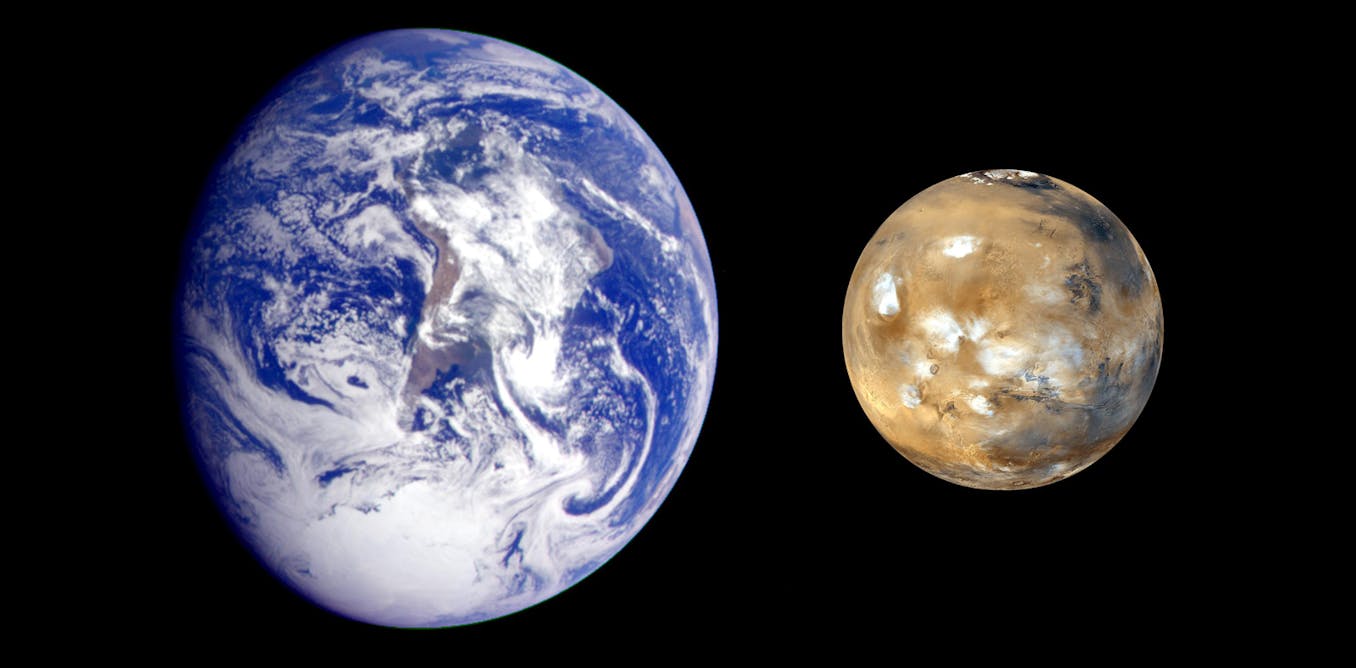
Are we the Martians? The intriguing idea that life on Earth began on the red planet

Published: December 29, 2025 10.33pm NZDT
Seán Jordan, Dublin City University

Nasa / JPL-Caltech
Link copied
Share article
How did life begin on Earth? While scientists have theories, they don’t yet fully understand the precise chemical steps that led to biology, or when the first primitive life forms appeared.

But what if Earth’s life did not originate here, instead arriving on meteorites from Mars? It’s not the most favoured theory for life’s origins, but it remains an intriguing hypothesis. Here, we’ll examine the evidence for and against.

Timing is a key factor. Mars formed around 4.6 billion years ago, while Earth is slightly younger at 4.54 billion years old. The surfaces of both planets were initially molten, before gradually cooling and hardening.

Life could, in theory, have arisen independently on both Earth and Mars shortly after formation. While the surface of Mars today is probably uninhabitable for life as we know it, early Mars probably had similar conditions to the early Earth.

Early Mars seems to have had a protective atmosphere and liquid water in the form of oceans, rivers, and lakes. It may also have been geothermally active, with plenty of hydrothermal vents and hot springs to provide the necessary conditions for the emergence of life.

You must log in or register to see images

Early Mars had flowing water that pooled in lakes. NASA/JPL-Caltech
However, about 4.51 billion years ago, a Mars-sized, rocky planet called Theia crashed into the proto-Earth. This impact caused both bodies to melt together and then separate into our Earth and its moon. If life had begun before this event, it certainly would not have survived it.

Get news from NZ's top academics in one weekly email.


Get newsletter
This site is protected by reCAPTCHA and the Google Privacy Policy and Terms of Service apply.
Mars, on the other hand, probably didn’t experience a global remelting event. The red planet had its fair share of impacts in the violent early solar system, but evidence suggests that none of these would have been large enough to completely destroy the planet – and some areas could have remained relatively stable.

So if life arose on Mars shortly after formation of the planet 4.6 billion years ago, it could have continued evolving without major interruptions for at least half a billion years. After this time, Mars’ magnetic field collapsed, marking the beginning of the end for Martian habitability. The protective atmosphere disappeared, leaving the planet’s surface exposed to freezing temperatures and ionising radiation from space.


Supercomputer simulation showing the collision between the Earth and a Mars-sized body that formed the Moon.

A question of timing​

But what of Earth: how soon did life appear after the impact that formed the Moon? Tracing the tree of life back to its root leads to a microorganism called Luca – the last universal common ancestor. This is the microbial species from which all life today is descended. A recent study reconstructed Luca’s characteristics using genetics and the fossil record of early life on Earth. It inferred that Luca lived 4.2 billion years ago – earlier than some previous estimates.

Luca was not the earliest organism on Earth, but one of multiple species of microbe existing in tandem on our planet at this time. They were competing, cooperating, and surviving the elements, as well as fending off attacks from viruses.

If small but fairly complex ecosystems were present on Earth around 4.2 billion years ago, life must have originated earlier. But how much earlier? The new estimate for the age of Luca is 360 million years after the formation of the Earth and 290 million years after the Moon-forming impact. All we know is that in these 290 million years, chemistry somehow became biology. Was this enough time for life to originate on Earth and then diversify into the ecosystems present when Luca was alive?

You must log in or register to see images

Luca’s habitat was either a shallow marine hydrothermal vent system or a geothermal hot spring, like this spectacular example in Yellowstone, US. NPS/Diane Renkin
A Martian origin for terrestrial life circumvents this question. According to the hypothesis, species of Martian microorganism could have travelled to Earth on meteorites just in time to take advantage of the clement conditions following the Moon’s formation.

The timing may be convenient for this idea. However, as someone who works in the field, my hunch would be that 290 million years is plenty of time for chemical reactions to produce the first living organisms on Earth, and for biology to subsequently diversify and become more complex.

Surviving the journey​

Luca’s reconstructed genome suggests that it could live off molecular hydrogen or simple organic molecules as food sources. Along with other evidence, this suggests that Luca’s habitat was either a shallow marine hydrothermal vent system or a geothermal hot spring. Current thought in the origin of life field is that these kinds of environments on the early Earth had the necessary conditions for life to emerge from non-living chemistry.

Luca also contained biochemical machinery that could protect it from high temperatures and UV radiation – real dangers in these early Earth environments.

However, it’s far from certain that early life forms could have survived the journey from Mars to Earth. And there’s nothing in Luca’s genome to suggest that it was particularly well adapted to space flight.

You must log in or register to see images

Did early life forms hitch a ride on Martian meteorites? SARAH YENESEL
In order to have made it to Earth, microorganisms would need to have survived the initial impact on Mars’ surface, a high speed ejection from the Martian atmosphere and travel through the vacuum of space while being bombarded by cosmic rays for at least the best part of a year.

They would then have needed to survive the high-temperature entry through Earth’s atmosphere and another impact onto the surface. This last event may or may not have deposited it in an environment to which it was even remotely adapted.

The chances of all of this seem pretty slim to me. However difficult the transition from chemistry to biology may appear, it seems far easier to me than the idea that this transition would occur on Mars, with life forms surviving the journey to Earth, and then adapting to a completely new planet. However, I could be wrong.

It’s useful to look at studies of whether microorganisms could survive the journey between planets. So far, it looks like only the hardiest microorganisms could survive the journey between Mars and Earth. These are species adapted to preventing damage from radiation and capable of surviving desiccation through the formation of spores.

But maybe, just maybe, if a population of microorganisms were trapped in the interior of a sufficiently large meteorite, they could be protected from most of the harsh conditions of space. Some computer simulations even support this idea. Further simulations and laboratory experiments to test this are ongoing.

This raises another question – if life made it from Mars to Earth within the first 500 million years of our Solar System’s existence, why hasn’t it spread from Earth to the rest of the Solar System in the following four billion years? Maybe we’re not the Martians after all.

Make 2026 the year you leave a legacy of knowledge.​

This New Year, resolve to make a lasting impact. By organising your Will, you protect your loved ones and ensure your values endure. Consider leaving a gift to The Conversation—an investment in free, fact-based journalism that informs and empowers future generations. Start your Will today and leave a gift that shapes the world you want to see.

Plan your legacy today

You must log in or register to see images

Misha Ketchell
Editor


Our Audience​

The Conversation has a monthly audience of 18 million users, and reach of 42 million through Creative Commons republication.

Want to write?​

Write an article and join a growing community of more than 217,000 academics and researchers from 5,400 institutions.

Register now
Privacy policyTerms and conditionsCorrections
Copyright © 2010–2025, The Conversation Media Group Ltd
 
  • Like
Reactions: Steelmonkey
Neom nightmare: How Mohammed bin Salman’s dream of a ‘city of the future’ became a $500bn disaster

Nearly a decade ago, the Saudi crown prince promised to build a gleaming utopia on the coast of the Red Sea that would redefine how human beings lived and worked. But experts say the scaling back of his project reveals that it was always an impossible dream in the first place, [COLOR=light-dark(rgb(239, 71, 87), rgb(239, 71, 87))]Alex Croft[/COLOR] reports[/COLOR]​
[COLOR=light-dark(rgb(211, 211, 211), rgb(211, 211, 211))]Saturday 31 January 2026 14:28 GMT[/COLOR]

[COLOR=light-dark(rgb(34, 34, 34), rgb(34, 34, 34))]

Bookmark popover​

Removed from bookmarks
Close popover[/COLOR]
You must log in or register to see images

You must log in or register to see images

[COLOR=light-dark(rgb(255, 255, 255), rgb(255, 255, 255))]What is The Line?[/COLOR]


[COLOR=light-dark(rgb(34, 34, 34), rgb(255, 255, 255))]Get a weekly international news dispatch[/COLOR]​

[COLOR=light-dark(rgb(34, 34, 34), rgb(255, 255, 255))]Email[COLOR=light-dark(rgb(162, 0, 33), rgb(162, 0, 33))]*[/COLOR][/COLOR]
SIGN UP

T
he then 32-year-old was laying out the most ambitious vision for a city in human history. His megaproject, Neom, would transform [COLOR=light-dark(rgb(235, 20, 38), rgb(235, 20, 38))]Saudi Arabia [/COLOR]from an economy dependent on oil to a global hub of innovation and prosperity.
Just months earlier, he had become the Kingdom’s de facto ruler, promising to usher in an era of idealism and technological revolution. This was his most daring gamble yet.
As part of the Neom project, more than £363bn would be pumped into the construction of a mountain ski resort, several coastal resorts and an industrial zone along the coast of the Red Sea.
You must log in or register to see images

open image in gallery

[COLOR=light-dark(rgb(100, 100, 100), rgb(189, 189, 189))]The linear city stretched for 200km in the desert (NEOM)[/COLOR]
But the jewel in Neom’s crown was The Line: a 170km megacity consisting of two gleaming 500-metre high skyscrapers cutting through the desert sky.
Less than a decade on from the announcement of Neom, the Saudi government appears to have admitted defeat. After a series of delays and ballooning costs, the Financial Times reported that the project would be scaled back.
Saudi officials now envisage Neom being something “far smaller” than the original design, but architects say the project was doomed from the start.
Promoted stories


3 Bed, 2 Bath For Sale In 1 Indira Place, Khandallah.SOTHEBY'S INTERNATIONAL R


“It’s an excellent example of a type of architecture where you propose something provocative to get a reaction. It’s always been an advertising gimmick for Saudi Arabia,” says Professor James Campbell, an architect and architectural historian at the University of Cambridge.
The majority of the architectural community shares his view, he claims, with some frustrated that the plan was not dismissed much earlier. “It’s ignored all the [engineering] problems. It’s just a big shiny wall.”
You must log in or register to see images

open image in gallery

[COLOR=light-dark(rgb(100, 100, 100), rgb(189, 189, 189))]The Line would have run entirely on renewable energy (NEOM)[/COLOR]
The limitations, he says, are not structural. In theory, it would be physically possible to build The Line – but the city does not make sense from an urban planning or financial perspective.
“As a building it makes no sense, and as a city it makes no sense – the perfect shape for a city is a tight circle”, he says, adding that the project is “economically not feasible”.
Riyadh does not deny immense overspending. “We spent too much,” one Saudi official said at an investment forum last November. “We rushed at 100 miles an hour. We are now running deficits. We need to reprioritise.”
You must log in or register to see images

open image in gallery

[COLOR=light-dark(rgb(100, 100, 100), rgb(189, 189, 189))]Architects say the project would have been impossible to build (NEOM)[/COLOR]
Prince Mohammed is reported to have come up with the idea for a linear city himself. The original design, put forward by Los Angeles architecture firm Morphosis, proposed a 2km-wide strip running from the sea to the mountains, connected entirely by rail.
But the crown prince’s ambition only grew. “I told the team, ‘how about if we take that two kilo[metres] and we flip it to two towers? Is that going to work, or is it going to be massive?’” he said in a documentary on the Discovery Channel.
The new brief envisaged a 200-metre wide city, housing 9 million people and operating without roads, cars or emissions. Officials said it would run on 100 per cent renewable energy.
You must log in or register to see images

open image in gallery

[COLOR=light-dark(rgb(100, 100, 100), rgb(189, 189, 189))]Crown prince Mohammed bin Salman unveiled Neom in 2017 (Discovery Channel)[/COLOR]
Morphosis, founded by star architect Thom Mayne, drafted the initial designs. Other major architecture and planning companies came onboard, including Adjaye Associates, Peter Cook and OMA.
Several firms, including Morphosis, have since left the Neom team as concerns grew around budget constraints and alleged human rights abuses on site.
The project is now being led by companies including Delugan Meissl Associate Architects, Gensler, and Mott MacDonald. It remains unclear what role they will play following the scaling back of Neom.
The Independent has reached out to most of the publicly-listed companies involved in the project, as well as Neom itself, but received no response.
You must log in or register to see images

open image in gallery

[COLOR=light-dark(rgb(100, 100, 100), rgb(189, 189, 189))]The futuristic city was set to be a home for 9 million people (NEOM)[/COLOR]
Despite skepticism, Prince Mohammed was consistently dismissive of those who doubted the project, claiming it would add $100bn to Saudi GDP by 2030.
But the crown prince was “overly ambitious right from the outset”, said Dr Neil Quilliam, associate fellow in the Middle East and North Africa programme at Chatham House.
Officials in Riyadh got “caught up in the enthusiasm of the changes that were taking
place”

but would privately have felt doubt over whether it could be achieved, he told The Independent.
You must log in or register to see images

open image in gallery

[COLOR=light-dark(rgb(100, 100, 100), rgb(189, 189, 189))]Officials say that the project will be significantly scaled back (NEOM)[/COLOR]
“At that particular time there was a buy-in to Saudi Arabia suddenly having this energy, this power and this will to do whatever it wanted, to really set a new agenda,” he said.
“It wanted to demonstrate there was a clear willingness and desire to demonstrate that the country was shifting and changing. In Neom, it was sort of laying that out.”
RECOMMENDED


Iran-Trump latest: Multiple dead in explosions as regime denies army chief targeted

New Epstein file photos appear to show Andrew Mountbatten-Windsor on floor with woman

Are you 18-79 with no funeral insurance? Talk to NZ Seniors todayNZ Seniors|

Sponsored

Summer Sale | Hot Offersifurniture|

Sponsored


As a result, the significant down-scaling of the project will be met with a “sense of embarrassment”, Dr Quilliam said. Prince Mohammed has gone through a series of “painful learning processes” during his time in power and will emerge with a stronger sense of “realism”, he added.
Future projects on the scale of Neom, he said, will be much less likely going forward as a result. For now, there will be no gleaming towers in the desert.

More about

[COLOR=light-dark(rgb(34, 34, 34), rgb(255, 255, 255))]Mohammad bin Salman[/COLOR][COLOR=light-dark(rgb(34, 34, 34), rgb(255, 255, 255))]Saudi Arabia[/COLOR][COLOR=light-dark(rgb(34, 34, 34), rgb(255, 255, 255))]Neom[/COLOR][COLOR=light-dark(rgb(34, 34, 34), rgb(255, 255, 255))]Design[/COLOR][COLOR=light-dark(rgb(34, 34, 34), rgb(255, 255, 255))]Innovation[/COLOR][COLOR=light-dark(rgb(34, 34, 34), rgb(255, 255, 255))]Crown Prince[/COLOR]

[COLOR=light-dark(rgb(34, 34, 34), rgb(255, 255, 255))]Join our commenting forum[/COLOR]​

[COLOR=light-dark(rgb(100, 100, 100), rgb(189, 189, 189))]Join thought-provoking conversations, follow other Independent readers and see their replies[/COLOR]

5
Comments

Promoted stories

Sleep Apnea? Try This Japanese Trick (It's Genius!)derilamemoryfoam.com

Claim your 150 free Spins!Jackpot City

Sleep Apnea Has Been Linked To a Common Habbit. Do You Do It?Derila Ergo

These Smart Reading Glasses Will Replace Every Pair You Ownopdgea-Reading

Claim Your 150 Free SpinsJackpotCity Casino

Here Are 21 of The Coolest Gifts for This 2025!WowGadgetsGo

Seashell Dream Off Shoulder Mini...Hello Molly NZ

Burning feet? This is what I use every night (brilliant!)Foot Relaxation


[/COLOR]
 
  • Like
Reactions: Steelmonkey
Jump to content


China unveils ‘Star Wars’ space carrier​

Vast triangular spaceship could evade conventional defences and bad weather to strike the enemy at will


277
Gift this article free


Allegra MendelsonAsia Correspondent
You must log in or register to see images

Allegra Mendelson is The Telegraph's Asia Correspondent based in Taiwan. See more
03 February 2026 6:00am GMT
China has unveiled plans for a space carrier that can deploy unmanned fighter jets capable of firing missiles from the edge of the Earth’s atmosphere.

State media released a concept video of the futuristic Luanniao, the world’s biggest warship, travelling through space above all current defensive systems.

Advertisement
ADVERTISEMENT
You must log in or register to see images

You must log in or register to see images

By Armstrong's

Drive Your Business Forward with the Peugeot Van Range at Armstrong’s Peugeot.
China claimed the carrier could become operational in 20 to 30 years’ time. However, experts were sceptical about the project and some likened it to a stunt designed to “inspire the Chinese public”.

Resembling a spaceship from a Star Wars film, the Luanniao will be a huge grey triangular aircraft carrier 242 metres long and 684 metres wide. It will have a take-off weight of 120,000 tons – significantly more than any similar craft in operation today.

According to state media, the Luanniao will be designed to carry up to 88 unmanned Xuan Nu fighter jets. These will reportedly be highly manoeuvrable stealth aircraft capable of launching hypersonic missiles, but will be significantly heavier than drones.

Advertisement

If completed, the new spaceship would “outclass pretty much everyone”, according to Peter Layton, a defence expert and a visiting fellow at Australia’s Griffith Asia Institute.

It would be capable of flying over surface-to-air missiles and other fighter aircraft, he said, adding: “You’re also out of range of the weather, generally speaking – and you’re out of range of most defensive systems.”

The Luanniao could also allow Beijing to position it directly above targets and launch missiles at them.

Such capabilities would give China a significant advantage, including over Taiwan and in the South China Sea, which could be the scene of a future war against the United States.

The Luanniao is part of China’s broader Nantianmen Project, which translates to South Heavenly Gate.

Developed by the Aviation Industry Corporation of China, the project encompasses a number of ambitious plans to expand the country’s air and space capabilities.

Advertisement
ADVERTISEMENT
You must log in or register to see images

You must log in or register to see images

By Armstrong's

Drive Your Business Forward with the Peugeot Van Range at Armstrong’s Peugeot.
One of the most prominent elements is a sixth-generation fighter, known as the Baidi fighter, that will also be able to operate near space. A model of the jet was displayed at China’s International Aviation and Aerospace Exhibition in 2024.

The Luanniao is the latest development in the ongoing space race between the US and China. Beijing has been investing in developing rockets and satellites in an effort to push the US out of the lead and, by some metrics, it is now winning.
You must log in or register to see images

Taiwanese coastguard vessels and speedboats simulate a response to a possible conflict with China Credit: Daniel Ceng/Anadolu via Getty Images
In 2024, China successfully launched the Chang’e-6, a robotic spacecraft, which reached the Moon’s far side and returned to Earth with lunar samples.

The Chang’e-7 mission, which has the goal of finding water on the Moon’s surface, is planned for August.

While the US still has leading capabilities, its momentum seems to be slowing while China’s is increasing.
You must log in or register to see images

The Chang’e-6 landed in the Inner *****lia desert after a nearly two month-long mission
The Luanniao, by far the most ambitious part of the Nantianmen Project, was first conceived more than 10 years ago, but was dismissed by most experts as a fantasy project. For many, it still is.

Advertisement
ADVERTISEMENT
You must log in or register to see images

You must log in or register to see images

By Armstrong's

Drive Your Business Forward with the Peugeot Van Range at Armstrong’s Peugeot.
The technology needed for an aircraft to hover at the edge of the Earth’s atmospheric boundary and launch missiles towards the surface does not currently exist. It would require “enormous amounts of fuel” as well as a new kind of propulsion system that had yet to be developed, said Mr Layton.
Recommended

How China is winning the military space race
Read more

One way in which China could achieve a similar result is by putting the carrier into orbit, similar to a satellite or rocket. However, in orbit the aircraft would be vulnerable to debris, which would destroy it in the event of a collision.

To launch the Luanniao into orbit, China would also need a reusable rocket. It has been working towards one for years, but has been unable to achieve it so far.

Advertisement
ADVERTISEMENT
You must log in or register to see images

You must log in or register to see images

By Armstrong's

Drive Your Business Forward with the Peugeot Van Range at Armstrong’s Peugeot.
Beijing could look to Elon Musk’s SpaceX reusable rockets for inspiration. However, the country is probably 10 to 15 years away from developing its own, said Mr Layton.
You must log in or register to see images

China has claimed the carrier could become operational in 20 to 30 years
Given the major obstacles around the development of the Luanniao, the timing of Beijing’s announcement is likely to be part of a wider strategy – both at home and abroad.

Mr Layton explained that China used stunts like this to “inspire the Chinese public” and show itself to be at the cutting edge of technological innovation.

Pushing the narrative around futuristic spacecraft was part of a greater effort to demonstrate to its neighbours that it was a leading military power, he said.

Advertisement
ADVERTISEMENT
You must log in or register to see images

You must log in or register to see images

By Armstrong's

Drive Your Business Forward with the Peugeot Van Range at Armstrong’s Peugeot.
“For the external audience, it does paint the picture that they are working on technology that the region just can’t aspire to – it’s literally Star Wars stuff,” he added.


Join the conversation​

Show277comments
The Telegraph values your comments but kindly requests all posts are on topic, constructive and respectful. Please review our commenting policy.
Related Topics
License this content

More stories​

Social worker sent sexual images to vulnerable


© Telegraph Media Group Holdings Limited 2026
 
Jump to content


China unveils ‘Star Wars’ space carrier​

Vast triangular spaceship could evade conventional defences and bad weather to strike the enemy at will


277
Gift this article free


Allegra MendelsonAsia Correspondent
You must log in or register to see images

Allegra Mendelson is The Telegraph's Asia Correspondent based in Taiwan. See more
03 February 2026 6:00am GMT
China has unveiled plans for a space carrier that can deploy unmanned fighter jets capable of firing missiles from the edge of the Earth’s atmosphere.

State media released a concept video of the futuristic Luanniao, the world’s biggest warship, travelling through space above all current defensive systems.

Advertisement
ADVERTISEMENT
You must log in or register to see images

You must log in or register to see images

By Armstrong's

Drive Your Business Forward with the Peugeot Van Range at Armstrong’s Peugeot.
China claimed the carrier could become operational in 20 to 30 years’ time. However, experts were sceptical about the project and some likened it to a stunt designed to “inspire the Chinese public”.

Resembling a spaceship from a Star Wars film, the Luanniao will be a huge grey triangular aircraft carrier 242 metres long and 684 metres wide. It will have a take-off weight of 120,000 tons – significantly more than any similar craft in operation today.

According to state media, the Luanniao will be designed to carry up to 88 unmanned Xuan Nu fighter jets. These will reportedly be highly manoeuvrable stealth aircraft capable of launching hypersonic missiles, but will be significantly heavier than drones.

Advertisement

If completed, the new spaceship would “outclass pretty much everyone”, according to Peter Layton, a defence expert and a visiting fellow at Australia’s Griffith Asia Institute.

It would be capable of flying over surface-to-air missiles and other fighter aircraft, he said, adding: “You’re also out of range of the weather, generally speaking – and you’re out of range of most defensive systems.”

The Luanniao could also allow Beijing to position it directly above targets and launch missiles at them.

Such capabilities would give China a significant advantage, including over Taiwan and in the South China Sea, which could be the scene of a future war against the United States.

The Luanniao is part of China’s broader Nantianmen Project, which translates to South Heavenly Gate.

Developed by the Aviation Industry Corporation of China, the project encompasses a number of ambitious plans to expand the country’s air and space capabilities.

Advertisement
ADVERTISEMENT
You must log in or register to see images

You must log in or register to see images

By Armstrong's

Drive Your Business Forward with the Peugeot Van Range at Armstrong’s Peugeot.
One of the most prominent elements is a sixth-generation fighter, known as the Baidi fighter, that will also be able to operate near space. A model of the jet was displayed at China’s International Aviation and Aerospace Exhibition in 2024.

The Luanniao is the latest development in the ongoing space race between the US and China. Beijing has been investing in developing rockets and satellites in an effort to push the US out of the lead and, by some metrics, it is now winning.
You must log in or register to see images

Taiwanese coastguard vessels and speedboats simulate a response to a possible conflict with China Credit: Daniel Ceng/Anadolu via Getty Images
In 2024, China successfully launched the Chang’e-6, a robotic spacecraft, which reached the Moon’s far side and returned to Earth with lunar samples.

The Chang’e-7 mission, which has the goal of finding water on the Moon’s surface, is planned for August.

While the US still has leading capabilities, its momentum seems to be slowing while China’s is increasing.
You must log in or register to see images

The Chang’e-6 landed in the Inner *****lia desert after a nearly two month-long mission
The Luanniao, by far the most ambitious part of the Nantianmen Project, was first conceived more than 10 years ago, but was dismissed by most experts as a fantasy project. For many, it still is.

Advertisement
ADVERTISEMENT
You must log in or register to see images

You must log in or register to see images

By Armstrong's

Drive Your Business Forward with the Peugeot Van Range at Armstrong’s Peugeot.
The technology needed for an aircraft to hover at the edge of the Earth’s atmospheric boundary and launch missiles towards the surface does not currently exist. It would require “enormous amounts of fuel” as well as a new kind of propulsion system that had yet to be developed, said Mr Layton.
Recommended

How China is winning the military space race
Read more
One way in which China could achieve a similar result is by putting the carrier into orbit, similar to a satellite or rocket. However, in orbit the aircraft would be vulnerable to debris, which would destroy it in the event of a collision.

To launch the Luanniao into orbit, China would also need a reusable rocket. It has been working towards one for years, but has been unable to achieve it so far.

Advertisement
ADVERTISEMENT
You must log in or register to see images

You must log in or register to see images

By Armstrong's

Drive Your Business Forward with the Peugeot Van Range at Armstrong’s Peugeot.
Beijing could look to Elon Musk’s SpaceX reusable rockets for inspiration. However, the country is probably 10 to 15 years away from developing its own, said Mr Layton.
You must log in or register to see images

China has claimed the carrier could become operational in 20 to 30 years
Given the major obstacles around the development of the Luanniao, the timing of Beijing’s announcement is likely to be part of a wider strategy – both at home and abroad.

Mr Layton explained that China used stunts like this to “inspire the Chinese public” and show itself to be at the cutting edge of technological innovation.

Pushing the narrative around futuristic spacecraft was part of a greater effort to demonstrate to its neighbours that it was a leading military power, he said.

Advertisement
ADVERTISEMENT
You must log in or register to see images

You must log in or register to see images

By Armstrong's

Drive Your Business Forward with the Peugeot Van Range at Armstrong’s Peugeot.
“For the external audience, it does paint the picture that they are working on technology that the region just can’t aspire to – it’s literally Star Wars stuff,” he added.


Join the conversation​

Show277comments
The Telegraph values your comments but kindly requests all posts are on topic, constructive and respectful. Please review our commenting policy.
Related Topics
License this content

More stories​

Social worker sent sexual images to vulnerable


© Telegraph Media Group Holdings Limited 2026

Maybe they can take Starmer with them, and drop him off on the far side of the moon
 
  • Like
Reactions: kiwiqpr